Finance/Tax Office
Annual Debt Statements
Annual Financial Statements
Audits
Budgets
Refuse Stickers Request
Veteran's Income Tax Exemption
Important Links:
- Burn Permit Application
- Commercial Zoning- Change of Tenancy- New Business Application
- Commercial Zoning Sign No Change of Ownership Permit
- Re-rent & Sale CO Application
- Crane and Heavy Machinery Application
- Rental License Registration
- Residential Pod Dumpster Zoning Application
- Residential Zoning Application
- Road Opening Permit
- Temporary Outdoor Dining/Retail Permit
- Vacant Property Registration Renewal De-Registration Application
Finance Office
The Finance Office is responsible for the receipt and disbursement of all municipal funds.
All revenues are recorded by the finance office and all purchases made by borough departments must first be approved by the finance office.
The Chief Finance Officer, works closely with all department heads to ensure compliance with fiscal and purchasing laws as set forth by the State of New Jersey Division of Local Government Services as well as the administration of each department’s respective budget. CFO assists the Mayor and Council in preparation of the annual budget.
In addition to revenue collection and purchasing, the Bound Brook Finance office is responsible for employee payroll and pension benefits.
Tax Office
The Tax Collector performs a wide range of duties including preparation and mailing of annual tax, refuse bills, posting and processing all tax payments, providing a variety of reports that reflect accurate collection and enforcing all State Statues regarding the collection of taxes.
ASSISTANCE PROGRAMS:
For more information, please visit the following websites:
Contact: 1-844-930-1778 or Call: 2-1-1.
Contact Information
Fax: 732-356-3662
- Mon - Fri
- -
- Sat - Sun
- Closed
Chief Finance Officer
Natasha Turchan
Tax Collector / Finance Clerk
Jodi Schneider
Payroll / Finance Clerk
Rosalia Fricano
Taxes are due:
- February 1
- May 1
- August 1
- November 1
A ten day grace period applies. When the tenth day falls on a Saturday, Sunday, or holiday, the next day the Borough is open will be the last day of the grace period.
To make payment or view your bill, please click here.
The State of New Jersey does not allow the tax collector to acknowledge postmarks. Taxes must be received in the collector’s office on or before the 10th. Payments are posted on the day that they are received in our office.
PLEASE NOTE: If you moved into a new home within the past year, it may be possible that your tax or sewer bill was received by the prior property owner. You can use our online payment system to check on the status of tax and sewer payments and to make sure that there are not any outstanding or missed payments.
**YOU DO NOT HAVE TO PAY YOUR BILLS QUARTERLY – PAYMENTS CAN BE MADE QUARTERLY OR IN FULL**
As of January 2023 sewer charges are part of your New Jersey American Water bill. THE BOROUGH IS NOT RESPONSIBLE FOR SEWER.
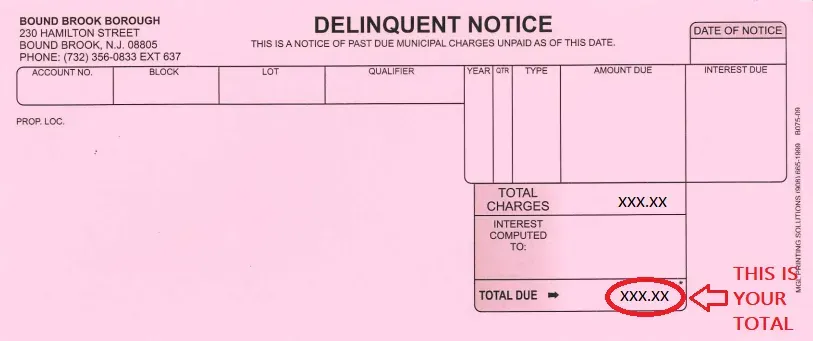
If payment is not received by the 10th of the month that the bill is due, it is delinquent and a delinquent notice will be mailed.
When the 10th day falls on a Saturday, Sunday, or holiday, the next day the Borough is open will be the last day of the grace period.
The interest is computed to a specific future date that is indicated on the notice. Payment must be received by the Tax Office, no later than 4 pm on the date indicated on the notice. The amount reflected on the notice, “TOTAL DUE” is the amount that should be submitted. If you do not make payment by the interest computed to date reflected on the notice, the amount due is not sufficient. If you are going to pay online, you can look up your total here. If you are mailing a check, please call the Tax Office, 732-356-0833 x636.
Description Title
FAQs – Frequently Asked Questions
When are property tax bills due?
Estimated 3rd quarter: You will receive an estimated 3rd quarter bill as a single stub. This is your 3rd quarter bill, due August 1. If you have a mortgage company, they will also receive this bill.
Final & Preliminary bills: You will receive four stubs: August (should have already been paid from your 3rd quarter estimated bill), and November for current year; and February and May for the following year.
What if I pay my property taxes through my mortgage company?
If you pay your taxes through your mortgage company, the statement will say, “Advice Copy Only”.
If you receive a “Advice Copy Only” statement, but do not have a mortgage company, use this statement to pay your taxes. Your mortgage company should send us a notice to remove your bank code.
What happens if I do not receive my bill?
Failure to receive a bill does not exempt you from paying your bill or any delinquent interest.
To obtain your bill:
– Go to boundbrook-nj.org, under “Tax Inquiry” – Search by Account Number or Block and Lot or Street Address or Owner Name
What do I have to do when selling my property?
When selling your property, your tax, sewer and refuse bills must be handed over to the new owner at the time of closing.
Sewer and refuse are not included in your property tax bills.
When are refuse bills mailed? When are refuse bills due?
Refuse bills are mailed once a year in June and contain four payment stubs. Refuse bills are due August 1 and November 1 for current year and February 1 and May 1 for the following year.
When are sewer bills mailed? When are sewer bills due?
The Borough no longer handles sewer billing. As of January 2023 sewer is part of your New Jersey American Water bill.
Drop-off payment for after hours:
There is a black drop box in the lobby of the building (parking lot entrance) for your convenience, open 24/7. Payments placed in the drop box after closing will be applied the next day.
**YOU DO NOT HAVE TO PAY YOUR BILLS QUARTERLY – PAYMENTS CAN BE MADE QUARTERLY OR IN FULL**
Tax Information
Quarterly Taxes Due:
February 1
May 1
August 1
November 1
A ten day grace period applies. When the tenth day falls on a Saturday, Sunday, or holiday, the next day the Borough is open will be the last day of the grace period.
The State of New Jersey does not allow the tax collector to acknowledge postmarks. Taxes must be received in the collector’s office on or before the 10th. Payments are posted on the day that they are received in our office. The tax office cannot accept post dated checks.
Please be sure to include your phone number on all checks.
Senior Freeze Property Tax Reimbursement Program
The Senior Freeze property tax reimbursement program has been a vital lifeline for many seniors and disabled individuals throughout New Jersey, helping to keep their property taxes stable so they can remain in their homes well into their golden years.
See all information here.
Payments/ Look Up Tax Information
Make Checks Payable to: Borough of Bound Brook
OR Click Below to Pay Online
Tax Programs
Tax Programs Available:
Senior Citizens Annual Property Tax Deduction-Annual deduction of $250.00 from property taxes for homeowners age 65 or older or disabled who have been in their home since October 1st of the pretax year, and whose income is less than $10,000/year, after a permitted exclusion of one of the following:
Social Security Benefits
Federal Gov’t Retirement/Disability Pension State, County
Municipal Government Pension
Veteran Deduction-Annual deduction of $250.00 from property taxes for qualified war veterans and their unmarried surviving spouses who have been in their home as of October 1st of the pretax year. Forms are available in the Tax Collector’s and Tax Assessor’s office.
Property Tax Relief Programs-Information about the Homestead Rebate or Property Tax Reimbursement (Tax Freeze) may be found on https://www.state.nj.us/treasury/taxation/relief.shtml or you can contact the Tax Office.
Homeowners Guide to Property Taxes
How are taxes computed?
The total tax levy to be collected is the sum of the local budget and the budgets of the school board and county board. This figure is divided by the total assessments in the township to produce the tax rate. That tax rate is then applied to individual assessments.
The 1st and 2nd quarter tax bills are preliminary, and equal to half of the total prior year taxes. The 3rd quarter is also estimated because the rate cannot be computed until all budgets have been approved; budget approval occurs in June. The final tax bill is computed by applying the new tax rate to the current year assessment, then deducting the amount billed for the first 3 quarters.
I need to change my address, or mortgage information. What should I do?
Escrow taxes with A Mortgage Company
An Initial Authorization Form from the Mortgage Company is needed.
This form, when signed by you, authorizes us to send your tax bill to the mortgage company.
Change your address
Complete the Address Change Form (PDF) and return it to the Tax Assessor: mimbriaco@boundbrook-nj.org or Tax Collector: jschneider@boundbrook-nj.org
Mortgage paid off
If you have paid off your mortgage and will now make tax payments to the Borough directly:
Written notice to stop sending the original bills to the mortgage company is necessary.
Please complete the Bank Code Removal Form (PDF) and return it to the Tax Collector.
When will I receive a new tax bill and when are they due?
 Button
August Tax bills (3rd Quarter) are mailed in June as a single stub. This is an Estimated bill which is due Aug 1st.
Final & Preliminary (4th Quarter current year and 1st & 2nd Quarters of the following year) bills are mailed at the end of August/beginning of September. This bill contains 4 perforated stubs for the 3rd (paid already) and 4th quarter of the current year, and the 1st and 2nd quarters of the next year. Original bills are mailed to those who pay their own taxes, as well as to banks and mortgage companies.
Property owners who pay their taxes through their mortgage company receive an Advice Copy of the tax bill. The advice copy can be used to make tax payments if a mortgage has been paid off by the property owner. Please read both the front and the back of the bill.
How should I pay my tax / refuse bill?
Tax and refuse payments may be paid by mail, in person or online. When paying by mail, please send a check with the appropriate payment stub or indicate the block & lot and purpose of payment on the memo line. The cancelled check will be the receipt. If you would like a receipt, kindly include a self-addressed stamped envelope and one will be mailed to you.
If you need to make payment outside of office hours and do not use the internet, payments can be placed in the drop box at the rear entrance of Borough Hall, seven days/week at any time, day or night. Payments must be in a sealed envelope labeled to the Tax Collector, with the name and phone number of the person making payment. Payments will be posted the next business day. Envelopes are provided at the drop box.
I didn’t receive a tax bill. Why should I be charged interest?
NJSA 54:4-64 states that failure to receive a bill does not invalidate taxes due; it is the property owner’s responsibility to ascertain from the proper official (Tax Collector) the amount due. If you have recently purchased the property, or lost your bill, you should call the Tax Office to obtain the amount due or visit www.boundbrook-nj.org >Tax Inquiry> look up your address and download/print a copy of the bill.
How should I make out my check?
ButtonUse this information to correctly fill out your check:
- Payable to the Borough of Bound Brook
- Place the account number or block and lot on the lower left corner of the check, known as the "memo line.”
- Date the check with the same date you are writing the check. No post-dated checks will be accepted
- Make sure both the numerical and written amounts match
- Ex. “$500” and “five hundred”
- Postmark is not accepted
- Please include a phone number on all checks
My mortgage company pays my taxes, what are my responsibilities?
An "Advice Copy" of your bill will be mailed to you, if your mortgage company pays your taxes. If an original copy of the tax bill is received, forward a copy to your mortgage company. Refuse bills are not paid by the mortgage company.
What do I need to do if I want to refinance or sell my home?
It is in the best interest of you, your mortgage holder and the new buyer that you have your current tax bill and refuse bill on hand at closing. Whether this is a refinance or sale, the new owner or your mortgage company will need to know the next quarterly amounts due.
What happens if I do not pay the property taxes?
ButtonA lien will be sold against the property if there are any unpaid taxes owed from the previous year, this may also include refuse and other municipal charges.
Unpaid taxes in the current year will accrue interest daily at the rate of 8% for the first $1,500 and 18% on balances more than $1,500.
What is a refuse bill? Who is responsible for payment? What if it doesn’t get paid?
ButtonThe Refuse bill is for garbage service. Payment is the responsibility of the property owner. Mortgage companies do not pay refuse.
As with taxes and other municipal charges, any unpaid refuse will accrue interest and balances owed from the previous year will be sold at the tax sale.
What is the interest rate on my delinquency?
The interest rate is 8% for the first $1,500 and 18% for any balances above $1,500. This will be charged back to the original due date or the last payment date, whichever is closer. There is a year-end penalty of 6% on properties that owe more than $10,000, including principal, interest.
What is a tax sale?
Every town is required by law to hold a tax sale annually. The Borough holds a standard online annual tax sale for those properties with balances due from the prior year. Delinquent prior year taxes, refuse, and other Borough charges will be sold to the highest bidder in the form of liens. The state requires that any property listed for tax sale be publicly published and posted in the Borough. The costs of publication and sale are added to the amount to be sold.
Upon the sale of these liens, the purchasers (Lien Holders) may pay the current year delinquencies and add those balances to the lien. Lien holders must wait 2 years before they can begin foreclosure of a property. The property owner may redeem the lien at any time prior to foreclosure, through the Tax Collector’s Office.
Learn more about tax sales (PDF).
Who buys these liens?
ButtonUsually, people/companies who are looking to invest money buy tax liens. The interest rate starts at 18%. However, if there is more than one person/entity interested in the same parcel, they will start bidding down the interest rate. Once the bidders bid down to 0%, it will go into a premium starting at multiples of $100.
What happens once a lien has been sold on a property?
The successful bidders will receive a legal document referred to as a "tax certificate" which must be recorded with the Somerset County Clerk’s Office. The certificate must be held for 2 years from the date of sale before foreclosure can commence. If the lien has not been redeemed by an interested party, after 2 years the lienholder may start to foreclose on the property. The homeowner has the right to redeem the tax sale certificate (PDF) any time prior to the final judgment being filed.
How do I redeem a lien?
You must submit a REQUEST in writing to the Tax Collector for a statement of redemption. At no time should you approach the lien holder directly. The request must include the EXACT date that you anticipate making payment and a statement of your legal interest in the property. The Collector will provide you with a payoff figure that is computed to the date of the redemption. You may be required to provide proof of identity. New Jersey Tax Sale Law only allows "interested parties" the right to redeem.
The only forms of payment are cash, certified check or money order. The Collector will notify the lien holder that payment has been received and request the lien certificate from the lien holder. This certificate will be forwarded to you. You will then have the lien removed at the Somerset County Clerk’s Office.
I receive a senior citizen deduction on my property, is there anything I need to do to maintain this deduction?
On or before March 1, taxpayers who receive certain tax deductions must file an Annual Post Tax Year Statement certifying their income for the prior year.
Learn more about senior and veteran tax deductions.
What programs are available to reduce taxes?
ButtonFind information about the programs available to reduce taxes:
A. NJ Property Tax Deductions:
Senior and Disabled Citizens
Senior citizens must be 65 years of age, own and reside in the property for which the deduction is being sought and meet income requirements. Total income, less the greater of Social Security or government pension income, must not exceed $10,000. For more information click HERE. Applications are available HERE, and Widow(er)s of eligible seniors may claim the deduction as well, if certain criteria are met. An annual update is required; forms will be mailed in January by the Tax Collector. Failure to return the form in a timely manner will result in the deduction being removed.
Disabled citizens must meet the criteria for Senior deductions, except for age. They must be receiving Social Security disability payments and provide a note from the doctor saying they are 100% disabled.
Veterans
Veteran eligibility information click HERE. Applications are available HERE. Widow(er)s of eligible veterans may claim the deduction as well.
Disabled Veterans may request 100% exemption from property tax payment. For eligibility information click HERE. Applications are available HERE. Restrictions may apply.
Each deduction reduces taxes by $250 per year. There is also an exemption for 100% disabled veterans, where the disability was caused by their service in the armed forces. Instructions are on the reverse side of all applications.
New Jersey Website to access the forms
B. Senior Freeze Reimbursement Program:
For details please visit: https://www.nj.gov/treasury/taxation/ptr/
Is there help for mortgage/tax assistance:
Emergency Rescue Mortgage Assistance (ERMA)
PROGRAM OVERVIEW:
Up to $75,000 per household for expenses which may include:
- Mortgage reinstatement
- Escrow shortages
- Delinquent property taxes and HOA dues/fees
- Municipal or property tax liens
- Mortgage payments, including principal, interest, taxes, and homeowner’s insurance
For more information visit https://www.nj.gov/dca/hmfa/erma/hub/